GamStop explained, the scheme, the periods, the checks
GamStop is a national multi-operator self-exclusion scheme, and the marketing copy that surrounds it, on the pages of offshore casinos aimed at UK adults, routinely misreads it. This page sets out what the scheme actually is, the three minimum periods it offers, the technical way the block reaches every UKGC-licensed site, what happens the day your period expires, the 24-hour cool-off that has to run before the block lifts, and the seven-year auto-extension that catches people who do nothing at the end of a term. The angle is editorial rather than promotional. It reads the scheme the way an advertising standards officer would read a claim about the scheme, from the top of the operator's home page down to the bottom of the terms and conditions, and it names the misreadings that recur when the scheme is described by parties who benefit from the scheme being misunderstood.
What GamStop is, plainly
GamStop is the national multi-operator self-exclusion scheme for online gambling in Great Britain. It is operated by the National Online Self-Exclusion Scheme Limited, a not-for-profit company set up by the trade body for the online gambling sector at the direction of the UK Gambling Commission, and it is now a licence condition for every remote operator that accepts customers in Great Britain to be integrated with it. When you sign the register, your identifying details are held in a central database and matched, in near real time, against every attempt to open a new account or log into an existing one at any of the operators that hold a UKGC remote licence. It is a public scheme, funded through the licence conditions that require operators to participate, and it is administered independently of the operators themselves. Nothing about the scheme is proprietary to any brand. It is a piece of public infrastructure that sits alongside the licence framework and shares the same statutory footing under the Gambling Act 2005 as amended.
Because the scheme is public infrastructure, the marketing that describes it on operator pages does not always sit under the same editorial standards as the marketing that describes the operators' own products. A licensed operator that carries the GamStop badge in its footer has the badge because the licence condition requires it, and the language it uses to describe the scheme is subject to the Committee of Advertising Practice non-broadcast code and to the operator's own responsible gambling policy. An offshore site that references GamStop in its marketing copy sits under neither of those regimes. It can, and does, describe the scheme in language that a UK-licensed operator would not be permitted to use. The mismatch is not a matter of ordinary editorial disagreement. It is a structural feature of the way the scheme is presented in the sector that markets itself around it, and the misreadings it produces are the reason this page exists.
02The three periods, and what each commits you to
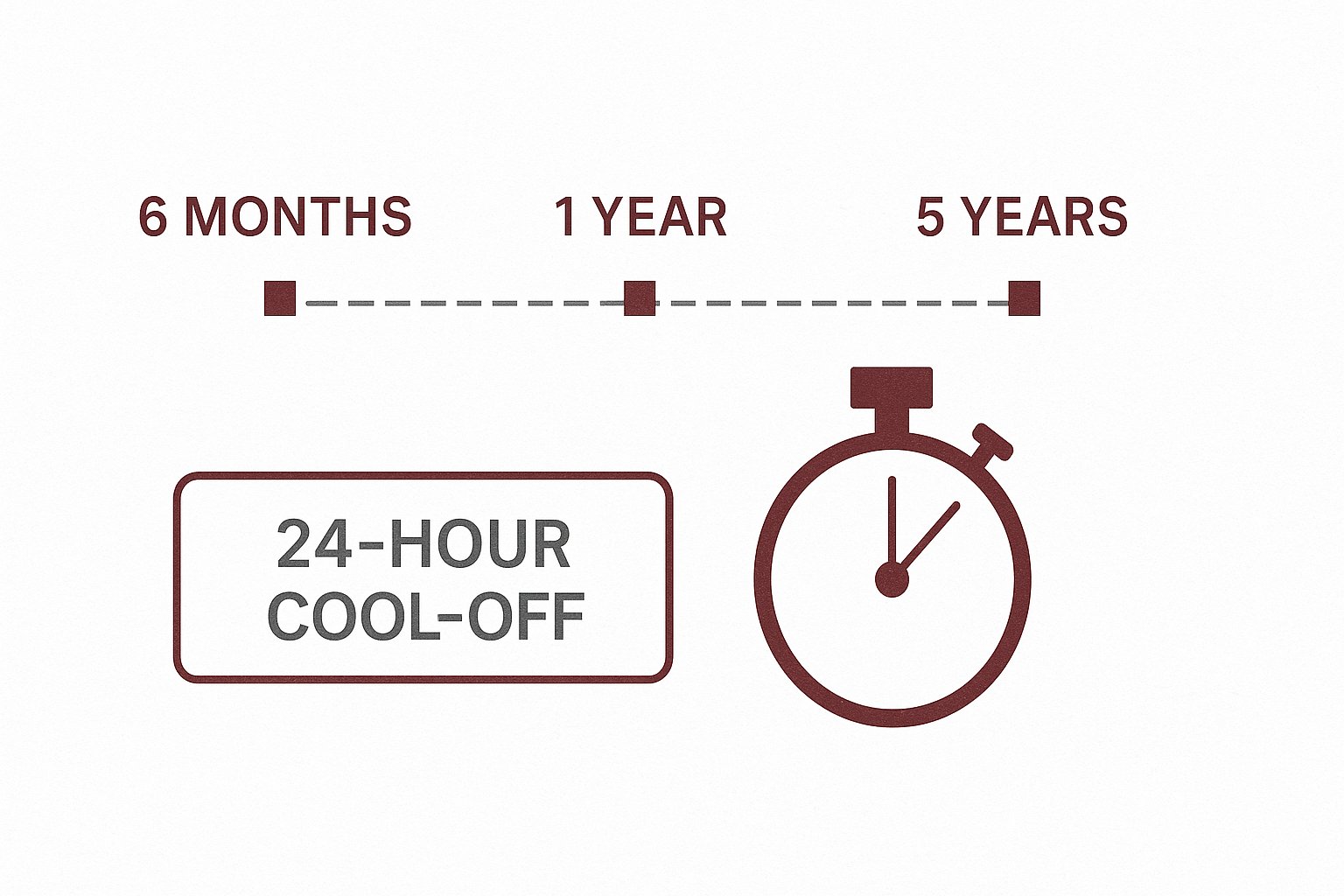
The scheme offers three minimum periods. You can sign the register for six months, one year, or five years. There is no shorter option and no longer single option. The choice is made once, at the point of registration, and it is not an ordinary consumer contract in which the customer holds a right of cancellation. The design of the scheme is that self-exclusion works only when it cannot be reversed in the moment, and the six-month floor was set with that principle in mind. Six months is long enough for the acute impulse that led to registration to lose its grip, long enough for a household to reorganise its finances without the recurring outflow that gambling was generating, and long enough for a person who signed the register in distress to be in a different place, emotionally and materially, at the moment the minimum period ends. The five-year option is offered for registrants who know from their own history that a longer horizon is what they need.
The one-year option sits between the two, and in practice it is the option that most registrants choose when they sign for the first time. None of the three periods is a probation and none is a review window. The scheme does not check on you during the period and the operators do not receive notifications about you. What happens for the length of the term you have chosen is that your registration returns a positive match every time you attempt to open a new account or log into an existing one at a UKGC-licensed operator, and the match causes the login or the registration to fail. Nothing else. The reason you cannot log in is that your details returned a match. There is no negotiation with the operator, no supervisor to appeal to, and no route by which the operator can override the match on your request.
A closer look
The reason the minimum period cannot be shortened is worth stating in one sentence, because it is often stated the wrong way round in offshore marketing copy. The minimum period cannot be shortened because a self-exclusion scheme that could be shortened would not work as a self-exclusion scheme. The design principle is precommitment, borrowed from the behavioural science literature that shaped the White Paper of 2023, and precommitment is only useful to the person who made the commitment if the commitment holds in the moment they most want to break it. Anything that softens the minimum period softens the mechanism by which the scheme delivers its benefit to the registrant.
03How the block reaches every UKGC-licensed site
The technical mechanism of the block is a matching system. When you register with the scheme, you provide your full legal name, your date of birth, your postcode, your address, your email address and a mobile telephone number. Those details go into the central register. Every remote operator that holds a UKGC licence runs an integration against that register, and when a customer attempts to open a new account or log into an existing one, the operator's system checks the applicant's details against the register. If a positive match is returned, the operator's system refuses the registration or the login. The reason the register asks for more than an email address is that people who are self-excluding sometimes want to test whether the block holds, and the register is designed to be difficult to circumvent by presenting slightly different information on a subsequent attempt. The scheme's match algorithm looks for combinations rather than exact strings, and it is deliberately tolerant of small variations.
That is what the scheme does at licensed sites, and it is worth being precise about what it does not do at offshore sites. The register is a UK piece of infrastructure integrated with UK licensees. It is not integrated with sites licensed in Curaçao, in Anjouan, in Kahnawake, or in any of the other jurisdictions from which the offshore sector serves the UK market. There is no technical route by which the register can be checked at an offshore site, and there is no legal route by which the operator of an offshore site can be compelled to check it. The absence of that check is the reason the offshore sector is able to open accounts for self-excluded UK adults. It is a mechanical absence, not an editorial one. The offshore operator's home page can describe itself as non-GamStop because it is genuinely not integrated with the register. That description, on its own, is factually accurate. The question of what the operator does or does not do with the absence is the subject of the risks page on the site.
04What happens when your period ends
The most common misreading of the scheme concerns what happens on the day your minimum period expires. It is often described in offshore copy as an automatic lifting of the block. It is not. The scheme does not lift the block on the day the minimum period ends. What happens on that day is that the registration becomes eligible to be lifted, and nothing else. Until the registrant contacts the scheme and asks for the block to end, the registration continues to return positive matches at every UKGC-licensed operator. That is the case one day after the minimum period ends, one week after, one month after, and one year after. Silence extends the block. Only an active request from the registrant sets the process of lifting in motion.
When the request arrives, the scheme runs a 24-hour cool-off before the block is lifted. The cool-off is not a paperwork window. It is a structural pause between the request and the moment the block clears the register. Its purpose is the same as the purpose of the minimum period itself. It is a slow gate at the point of exit, deliberately placed so that a request made in a moment of pressure has 24 hours to be reconsidered before it takes effect. If the request is not withdrawn during the cool-off, the block lifts at the end of it, and the scheme sends a written confirmation. Until the confirmation arrives, the registration is still in force, and the licensed sector will still return positive matches on the registrant's details. This distinction between the moment of the request and the moment of the confirmation is worth carrying with you, because it is the practical difference between the block being in place and the block not being in place.
Key points
- Three minimum periods only, six months, one year or five years, chosen at registration and not shortenable
- Register matches your details, in near real time, against every UKGC-licensed remote operator
- End of the minimum period does not lift the block, an active request and a 24-hour cool-off are required
- Silence at expiry triggers a further seven-year auto-extension
- Scheme is not integrated with sites licensed outside the United Kingdom
The twenty-four hour cool-off explained
The 24-hour cool-off is often described, in the marketing copy this page was set up to read carefully, as a bureaucratic inconvenience. It is not. It is the second protective mechanism the scheme carries, and it is smaller in duration than the minimum period only because it is the tail of a longer intervention rather than the whole of one. The cool-off exists because the moment at which a registrant asks for a block to be lifted is, statistically, the moment at which the impulse that led to the registration has returned. That is not always true, but it is true often enough that a scheme designed to protect the person who signed the register has to hold that moment open for reconsideration. Twenty-four hours is short enough not to overreach and long enough for the impulse to loosen, and the number is a deliberate calibration rather than a round-figure default.
The practical shape of the cool-off is a period during which the registration remains active on the register, exactly as it was during the minimum period, and any attempt to open a new account or log into an existing one at a UKGC-licensed operator will fail. That is the case for every hour of the twenty-four, and the confirmation communication that the scheme sends at the end of the cool-off is the moment at which the block actually lifts. It is worth reading the confirmation when it arrives. It carries the date and time of lifting, the identity used on the register, and a plain statement that the account can now be opened. If you have not received the confirmation, the block has not lifted. If you have received an email that looks like a confirmation but that was not sent by the scheme, the block has still not lifted. The scheme's confirmation is the operative document.
A closer look
Two questions come up in the correspondence the editorial team receives on this section. The first is whether the cool-off can be shortened on request. It cannot. The second is whether the cool-off is triggered by the end of the minimum period rather than by the request. It is triggered by the request. Until an active request is made, the registration continues to return positive matches indefinitely, and the twenty-four hours have not begun. The two questions taken together account for the majority of the reader queries the site receives on the mechanics of exit, and both are worth carrying in mind before a request is made.
06The seven-year auto-extension nobody warns you about
If a minimum period reaches its end and the registrant takes no action, the scheme extends the exclusion for a further seven years. The extension is documented in the scheme's own materials but it is rarely mentioned in the offshore marketing copy that describes GamStop for a UK audience. That is a legible pattern. The auto-extension is inconsistent with the framing that offshore sites tend to prefer, which is that GamStop is a short-term measure a UK adult signs up for in a moment and can walk away from at the end of the minimum period. In fact, the scheme is designed on the opposite presumption. Its default is to protect. If nothing is heard from the registrant at the end of the minimum period, the scheme reads that silence as a continuation of the original intention and keeps the block in place for seven further years.
The seven-year figure is worth carrying. Read as a duration, it is long enough that a person who registered for a one-year term and then said nothing at the end of it can, in effect, remain on the register for eight years. Read as a design decision, it is the counterpart to the 24-hour cool-off at the other end of the term. The cool-off holds the exit open for a moment. The auto-extension holds the block in place if the exit is never requested. Together the two features describe a scheme that is more careful about ending self-exclusion than about beginning one, and that is the correct order for a piece of infrastructure whose purpose is to protect the registrant against their own future impulses. It is a feature of the scheme, and one that a person considering registration should be told about at the point of registration.
GamStop and the wider harm-reduction picture
The scheme sits inside a wider architecture of harm-reduction measures that has moved considerably in the past three years. The White Paper published in 2023 under the title High Stakes, Gambling Reform for the Digital Age (CP 835), the online slot stake caps of £2 to £15 that followed, the affordability check framework that the UK Gambling Commission has been building out, and the Statutory Levy that came into force on 6 April 2025 under the Gambling Levy Regulations 2025 are all pieces of the same picture. GamStop is the piece the customer touches, and the piece that most closely resembles a mechanism the customer operates for themselves, but it does not stand alone. It sits alongside the bank blocks that HSBC, Monzo, Starling, Lloyds and Barclays now offer on consumer cards, alongside the merchant category enforcement that Visa and Mastercard have tightened through their 2025 taskforce with the Gambling Commission, and alongside the treatment pathways that the NHS gambling clinics now provide across England, Wales and Scotland.
Reading the scheme in that wider context matters because the offshore marketing that discusses GamStop rarely reads it in that context. It presents the scheme as a stand-alone barrier that a self-excluded person is now free to route around, and it does so without reference to the payment friction that the bank blocks and the acquiring-end enforcement now add, and without reference to the treatment routes that the state and the charitable sector maintain for the person whose self-exclusion was a response to harm. A responsible reading of the scheme places it inside the architecture it belongs to. The scheme is one layer of a defence in depth, and the value of a layer is best judged in company with the layers next to it rather than in isolation from them.
08Common misreadings of the scheme
Four misreadings recur in the offshore marketing copy that a former advertising standards editor would flag as a matter of routine. The first is the suggestion that GamStop can be cancelled on request during the minimum period. It cannot. The second is the suggestion that the scheme lifts the block automatically at the end of the minimum period. It does not. The third is the suggestion that a third-party removal service can shorten a registration on the customer's behalf. It cannot, and any operator or affiliate who advances the suggestion is describing a service that does not exist. The fourth is the suggestion that non-GamStop operators are, by virtue of the phrase, somehow subject to the responsible gambling standards that the phrase implies. They are not. The word non-GamStop is a factual description of the operator's non-integration with the register. It is not a statement about the operator's licensing or its responsible gambling practices.
Each of the four misreadings is legible as an advertising phenomenon. Each serves a commercial purpose for the party writing it. Each would fail a substantive reading against the CAP Code if it were being made by an advertiser subject to the code, which the offshore operators are not, and each is therefore worth reading with the same care that the code would apply if it did. The purpose of this page is to hold the misreadings up against the scheme as it actually exists, to name the mechanisms that the marketing tends to omit, and to leave the reader in a position to read the next piece of copy about GamStop, from any source at all, with the four misreadings in mind. If the copy makes any one of them, the copy is not describing the scheme accurately, and the reader is entitled to weight what it says accordingly.
Read next
- The legal position for UK players outside GamStop
- The risks, explained without the marketing
- Payments and checks, banks, cards, crypto, KYC
- Coming off GamStop, the official route
- Getting support, helplines, clinics, family, money
Sources and verification
The mechanics of the scheme described on this page, including the three minimum periods, the register match, the 24-hour cool-off and the seven-year auto-extension, are drawn from the scheme's own public materials at gamstop.co.uk. Last checked 5 August 2026.
Frequently asked questions
Is GamStop the same as self-exclusion at a single site
No. Self-exclusion at a single operator applies only to that operator. GamStop is a national scheme that matches your registered details against every remote operator holding a UK Gambling Commission licence, and the block applies simultaneously across the whole licensed sector for the minimum period you chose.
Can a GamStop registration be shortened once it is active
No. Once a minimum period is active it runs to its end. The scheme will not shorten a registration for any reason, and no third party has the technical or legal ability to shorten one on your behalf. Marketing that suggests otherwise is inaccurate.
What happens the day my GamStop period expires
Nothing happens automatically. The registration remains in force until you actively contact the scheme and ask for the block to end. A 24-hour cool-off then runs between your request and the moment your registration clears the register, and the scheme sends a written confirmation when the block has actually lifted.
Does GamStop cover offshore or non-UKGC operators
No. The GamStop register is technically integrated with UK Gambling Commission licensees only. Sites licensed outside Great Britain are outside the scheme's reach. That is the mechanical reason a self-excluded UK adult can, in practice, register at an offshore site while GamStop is active.
What is the seven-year auto-extension
If a registration reaches the end of its minimum period and the registrant takes no action, the scheme extends the exclusion for a further seven years on the presumption that inaction indicates a continued preference for the block to remain in place. The extension is a safety default, not a penalty.
Talk to someone today
The National Gambling Helpline is free, confidential and open 24 hours a day, seven days a week.